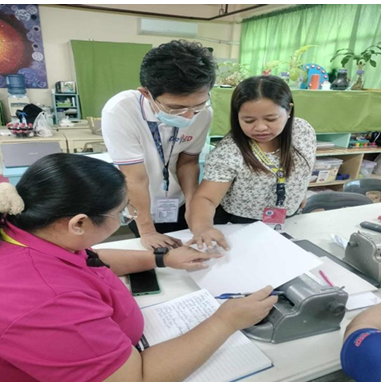
With a renewed commitment to inclusive education, the Philippine National School for the Blind conducted a focused Learning Action Cell (LAC) session on September 20, 2024, aimed at enhancing teaching approaches for Basic Braille literacy among non-graded learners. The session emphasized that every tactile dot mastered is a step toward independence, confidence, and lifelong learning—a powerful reminder of the school’s mission to empower learners with visual impairments.
Held at the Non-Graded Classroom and facilitated by Teacher Kelly Larry Bucayo, the session brought together dedicated educators and staff to explore strategies that better address the diverse needs of learners with visual impairments. The session opened with a discussion led by Ma’am Memie, who underscored DepEd Memorandum No. 50, s. 2020, reaffirming the role of LAC sessions in strengthening continuous professional development for teachers. She highlighted the urgency of equipping educators with the right tools and approaches to support Braille literacy, especially for students preparing for grade-level transitions.
Teachers were introduced to a wide range of Braille writing tools—from the Swing Cell and Peg Slate to the Perkins SMART Brailler and Braille Note—allowing them to understand the varied technological options available for different learner needs. This segment helped educators appreciate how accessible tools can significantly improve tactile learning, comprehension, and communication among visually impaired students.
The session also examined the developmental importance of Braille in non-graded learners. Discussions highlighted how Braille supports customized learning pacing, reinforces multi-sensory engagement, and builds structured routines that enhance stability and focus. Teachers also learned how Braille contributes to emotional development, providing learners with moments of achievement and boosting their self-esteem. The group emphasized that every small progress in Braille literacy contributes meaningfully to a learner’s independence and capacity to participate actively in their daily environment.
A second session led by Ma’am Violeta expanded on essential Pre-Braille skills such as tactile discrimination, finger isolation, object permanence, auditory skills, and directional awareness. Teachers explored practical, hands-on activities—including matching textures, tracing raised lines, manipulating small objects, and engaging in sound recognition exercises—which are foundational in preparing learners for formal Braille instruction.
The collaborative discussions fostered a dynamic exchange of best practices, with educators sharing their methods and insights in teaching learners who require highly individualized instruction. By the end of the session, teachers expressed strengthened confidence in applying more effective, compassionate, and developmentally appropriate approaches in their classrooms. The meeting adjourned at 4:45 p.m., concluding a meaningful afternoon dedicated to professional growth and learner-centered education.
Through this LAC initiative, PNSB continues to reinforce its commitment to providing quality, accessible education to learners with visual impairments. With improved competencies and renewed motivation, teachers are better equipped to guide non-graded learners on their Braille literacy journey—ensuring that no learner is left behind.