Menu

VISUAL IMPAIRMENT AWARENESS

FAQ: FREQUENTLY ASKED QUESTIONS ABOUT VISUAL IMPAIRMENT

Essential information, guidelines, and resources to support learners with visual impairment.

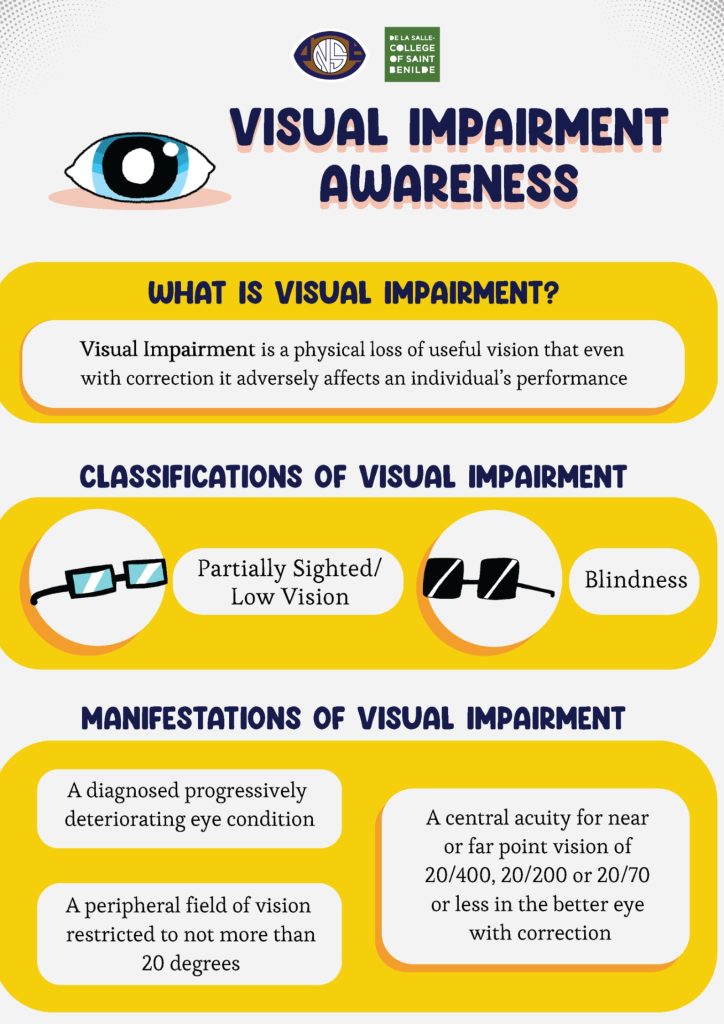
What is visual impairment?

Visual impairment means a person has a level of vision loss that affects daily activities, learning, or mobility. It includes low vision and blindness.

What causes visual impairment?

Causes include congenital conditions (from birth), illnesses, accidents, refractive errors, and age-related eye diseases. Some causes can be corrected, while others cannot.

What is the difference between low vision and blindness?

Low Vision
A person with low vision still has usable sight but has difficulty seeing even with eyeglasses. They may see blurred shapes, limited details, or only within a small area. 

Blindness
Blindness means a person has very limited vision or no functional vision at all. Some may still detect light, shadows, or movement, while others may have no light perception

What teaching strategies work best for students with VI?
  • Give verbal descriptions of visual content

  • Provide Braille, large print, or audio materials

  • Use hands-on and tactile learning

  • Allow extra processing time

  • Include assistive technology like screen readers

How do students with VI read and write?

They may use:

  • Braille

  • Large print

  • Screen readers (NVDA, JAWS, VoiceOver)

  • Audio books

  • Note-taking devices or tablets

How do learners with VI take quizzes and exams?

They may answer through:

  • Braille test papers

  • Large-print versions

  • Oral exams

  • Audio format

  • Digital tests using screen readers

  • A reader or scribe, if needed

What school accommodations should be provided?
  • Accessible learning materials

  • Extra time for written tasks

  • Clear seating near the teacher

  • Clutter-free paths in the classroom

  • Assistive devices (magnifiers, tablets, tactile tools)

How do I guide a learner with VI safely?
  • Offer your elbow instead of pulling them

  • Walk at a natural pace

  • Warn them about stairs, uneven floors, doors, or obstacles

  • Do not rearrange the classroom without telling them

What is the Expanded Core Curriculum (ECC)?
  • Orientation & Mobility

  • Assistive Technology

  • Independent Living Skills

  • Career Education

  • Social Interaction Skills

  • Recreation and Leisure

  • Sensory Efficiency

  • Self-Determination

How can teachers make lessons more accessible?
  • Read aloud what is written on the board

  • Describe images and charts

  • Provide digital copies for compatibility with screen readers

  • Use tactile materials

  • Give enough time for note-taking and movement

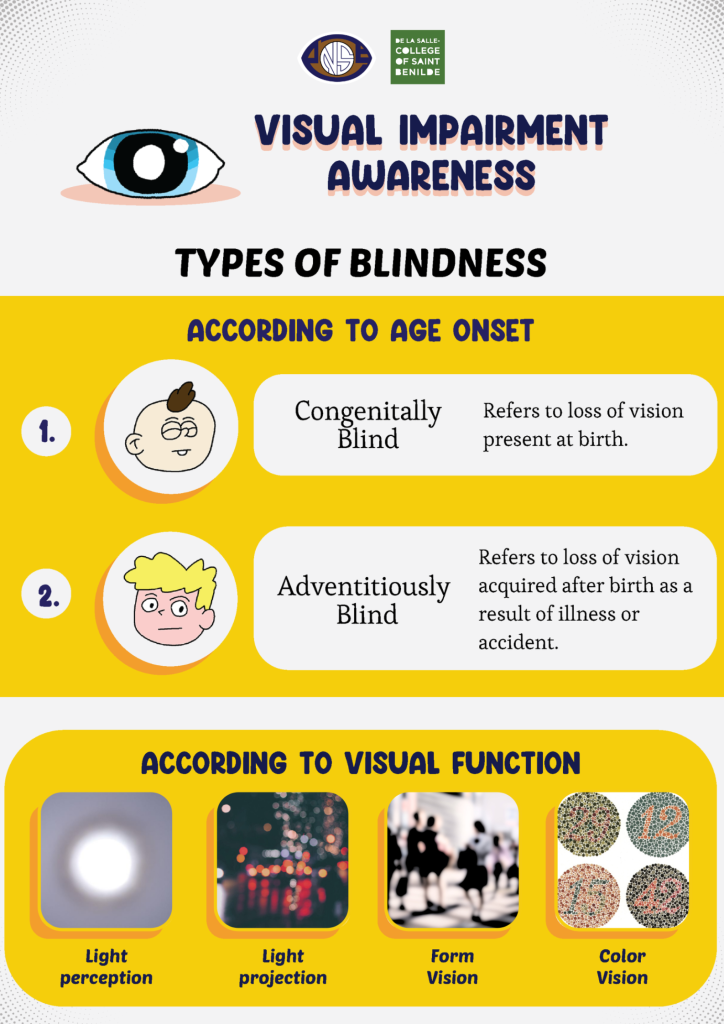
Infographic titled “Visual Impairment Awareness.” At the top are two logos: the Philippine National School for the Blind and the De La Salle–College of Saint Benilde. A cartoon-style eye illustration appears below the logos. Main Heading: Types of Blindness Section 1: According to Age Onset 1. Congenitally Blind Illustration: A cartoon baby with closed or unfocused eyes. Text: “Refers to loss of vision present at birth.” 2. Adventitiously Blind Illustration: A cartoon child with straight yellow hair. Text: “Refers to loss of vision acquired after birth as a result of illness or accident.”

How to Assist a Person with Visual Impairment & its Misconception
Filipino 

How to Assist a Person with Visual Impairment & its Misconception.                            English