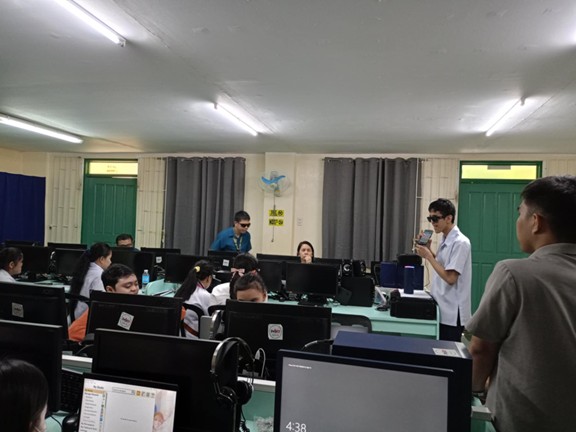
Pasay City, Philippines — To strengthen the successful transition of graduating students with visual impairments into higher education and the workforce, the Philippine National School for the Blind (PNSB) conducted a two-day training-workshop titled “Empowering Independence: Championing Against Academic and Work Environments’ Challenges with Assistive Technologies” on April 2–3, 2025, at the school’s Senior High School E-Lab.
The activity aimed to upskill 16 Grade 12 students in using assistive tools and digital platforms, enhancing their ability to independently navigate academic and professional settings. The workshop prioritized practical, hands-on experience with technologies designed to tackle real-world challenges in accessing educational content and managing personal mobility.
The event formally opened with a short program featuring a message from School Principal Dr. Nora S. Pablo, who emphasized the vital role of technology in promoting independence among learners with visual impairments.
The first day of training addressed two common challenges encountered by students: accessing inaccessible materials and developing mobility independence.
In the session “Unpacking Inaccessible Materials,” led by Mr. Jun Jun Limbo, students explored tools such as Seeing AI and Envision AI to interact with content in complex formats like image-based documents and PDFs. This was followed by the session “Mastering Mobility Independence,” which introduced learners to GPS-based applications like Lazarillo and Grab. Students practiced booking rides and interpreting directions through auditory guidance—gaining real-world tools for safer, more independent travel.
On the second day, the training continued with “Maximizing Online Resources,” facilitated by Ms. Mabel S. Gaerlan. This session introduced participants to digital libraries such as Bookshare and assistive reading apps like Dolphin EasyReader, empowering students to independently search for, download, and read academic materials using screen reader-compatible platforms.
The final session, “Navigating Virtual Support Tools,” also led by Ms. Gaerlan, focused on remote access applications such as TeamViewer and NVDA Remote. Students learned how to request and receive virtual assistance when facing technical difficulties—minimizing dependence on physical support and strengthening self-sufficiency.
Both days concluded with presentations of learning and output demonstrations, where students confidently showcased their new competencies in document access, mobility, and virtual collaboration.
The workshop wrapped up with a closing program featuring reflections from selected students and the awarding of certificates by Mrs. Janice Villaro, Administrative Officer IV, Mrs. Gemma D. Soriano, Senior High School Head, and Ms. Agnes “Aggie” Angeles, Country Outreach Program Coordinator of Bookshare Philippines. Ms. Angeles also delivered the closing remarks, commending the students for their active participation, remarkable growth, and resilience throughout the training.
The successful implementation of this training-workshop was made possible through the collective efforts of PNSB’s dedicated faculty and staff, with generous support from Benetech, Inc. and Bookshare Philippines. This initiative is a testament to the school’s commitment to preparing learners with visual impairments to thrive in inclusive, accessible, and competitive environments.
PNSB remains steadfast in championing educational equity by integrating assistive technologies into its programs—ensuring that no learner is left behind in the digital age.